Beam Angle
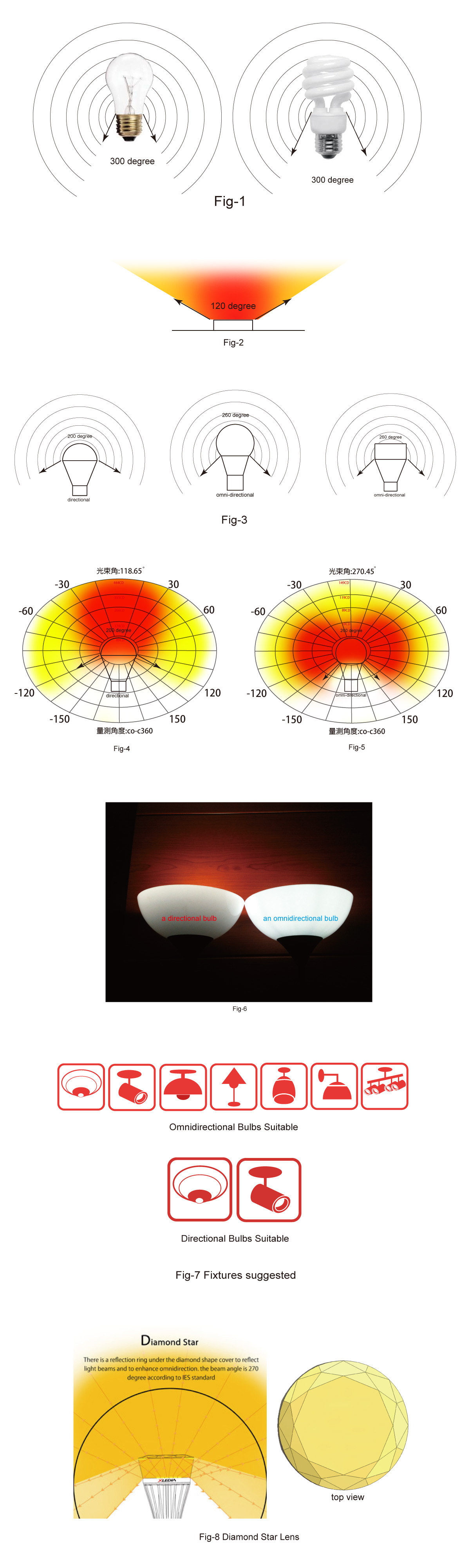
Beam Angle Generally speaking, incandescent bulbs and compact fluorescent bulbs emitted light beams in around 300 degree, shown in Fig-1. We say that their beam angles are omni-directional. When it comes to LED, there are 2 types, directional and omni-directional. LED chip emits light beams in narrow angle, usually 120 degree, as shown in Fig-2. It is not much trouble to design directional LED bulbs. Most of manufactures want customers to feel familiar to buy and to fit into most of existing light fixtures. They made their directional LED bulbs look like incandescent light bulbs. But, it takes more works to design omni-directional LED bulbs due to the nature of LED narrow beam angle. Manufacturers must play some tricks to spread LED’s light beams to wider angle. That’s why you see LED light bulbs in so many different shapes on markets. Here are some examples shown in Fig-3.
Directional bulbs spread most of light beams in 120 degree as shown in Fig-4 and Omnidirectional bulbs spread in 260 degree as shown in Fig-5. So, if you compare a directional LED bulb of 1600 lm with an omnidirectional LED bulb, you can find that the directional LED bulb has much more light toward its front and the omnidirectional LED bulb has much more light toward its sides. Here comes a question. Where do you need directional or/and omni-directional LED bulbs to install in? If you spread same amount of light in a narrow angle area, you can get more light in that area. For example, you use a directional LED bulb of 1600 lm and an omni-directional LED bulb of 1600 lm on same ceiling. You can get much better brightness under the directional LED bulb than you can get under the omni-directional LED bulb. It is like you spread same amount of water on a smaller area and a wider area. So, when you install a LED bulb on ceilings, it is better to choose directional LED bulb. Directional LED bulbs have a disadvantage. Its beam angle is around 120 degree. When you install it in light fixtures like shown in Fig-6, you can find that the lampshade is dark. In this case, you need omni-directional LED bulbs as shown in Fig-6. So, now you know what differences are between directional and omnidirectional LED bulbs. Generally speaking, If you need side light from a LED bulb or to avoid a dark lampshade, for example, desk lamps, you choose omnidirectional bulbs. If you need a more efficient down light, you choose directional bulbs. Here are some hits showing in Fig-7 which may help.
Another general rules to make choices. Choose directional when the bulb is oriented face down or such that all light needs to be directed to a certain area. Choose omni-directional when you need light to go towards all directions to illuminate a fixture or space.
It is quite trouble, isn’t it? Is there any bulb for all purposes available on the markets? Yes, there is. XLEDIA designed special lens which we called diamond stars as shown in Fig-8. This special designed lens can reflect just enough light beams to keep lampshade bright and still lead most of its light toward its front. So, you can have strong light beams to illuminate your need and still have shining lampshade. One extra saving is that you do not need to buy all different types of LED bulbs for your various light fixtures at home and you can switch the LED bulbs from one fixture to the others.